You dictate, and the chart writes itself.
Dentlog keeps the chart from dictation, during treatment: you say what you see, the system records it to dental standards and instantly draws the visual tooth map. Your assistant's note-taking time is freed up for patients.
Why it pays off
Three things your practice feels in the first week
Time
Charting today ties up your assistant's hands and your attention. With Dentlog, capture happens during treatment, with no separate admin round.
Accuracy
Instead of free text, structured, standard data is created: tooth number, surface, procedure. Searchable, filterable, and unambiguous long after the visit.
Continuity
With a returning patient, the last state is one glance, and only the change needs recording. Nothing is lost even if a colleague takes over the patient.
The app
Designed to live next to the dental chair
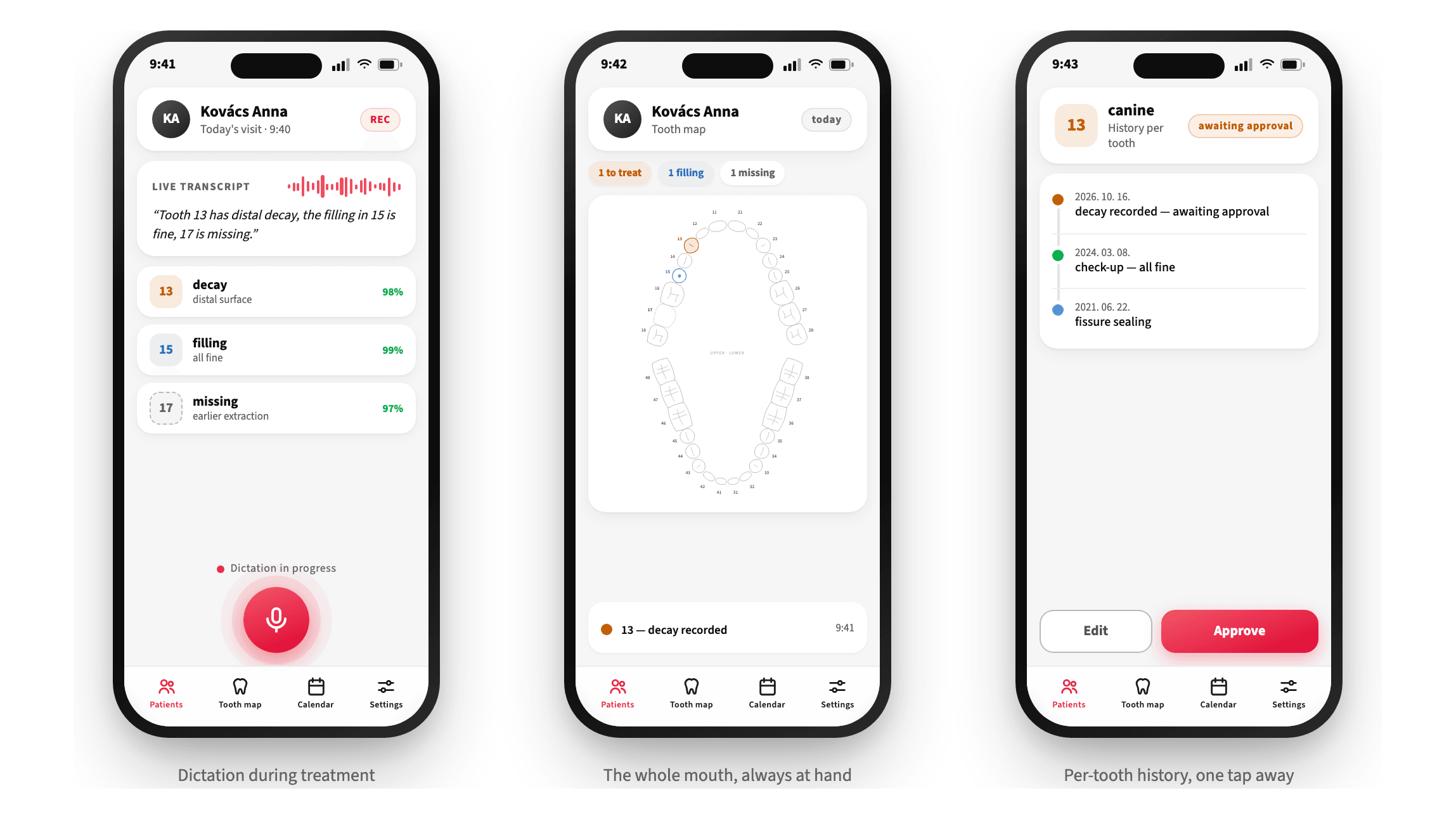
It runs on phone and tablet — fits in one hand, and you never have to touch it while dictating.
How it works
From dictation to a finished chart
One loop at the chair: you speak, Dentlog structures, you approve. With a returning patient, you only say the change.
Dictation
during treatment, hands-free
AI interpretation
dental vocabulary, FDI numbering
Structured tooth data
an entry per tooth
Chart + tooth map
updates instantly
Doctor approval
finished chart, audit log
A chart you can read at a glance
From the dictated text, Dentlog draws a visual tooth map — it shows exactly what you said. Below, the example sentence above, rendered.
“Tooth 13 has distal decay, the filling in 15 is fine, 17 is missing.”
Dentlog interprets the sentence, updates the chart and redraws the tooth map — nobody types a single line.
Tapping any tooth opens its own history: when, what happened, who recorded it. The latest visit's changes are highlighted.
What happens without treatment?
The tooth map doesn't only show the present: a draggable timeline shows what to expect in 3, 5, 10 or 20 years if the dictated problems stay untreated. The patient doesn't need an explanation — they see it. Drag the slider:
Getting a treatment plan accepted is one of the hardest parts of practice work — the patient decides when they see the stakes. Dentlog shows it in a single gesture.
The simulation is based on general dental progression patterns and serves as illustration — not an individual medical prediction. The doctor decides when and to whom to show it.
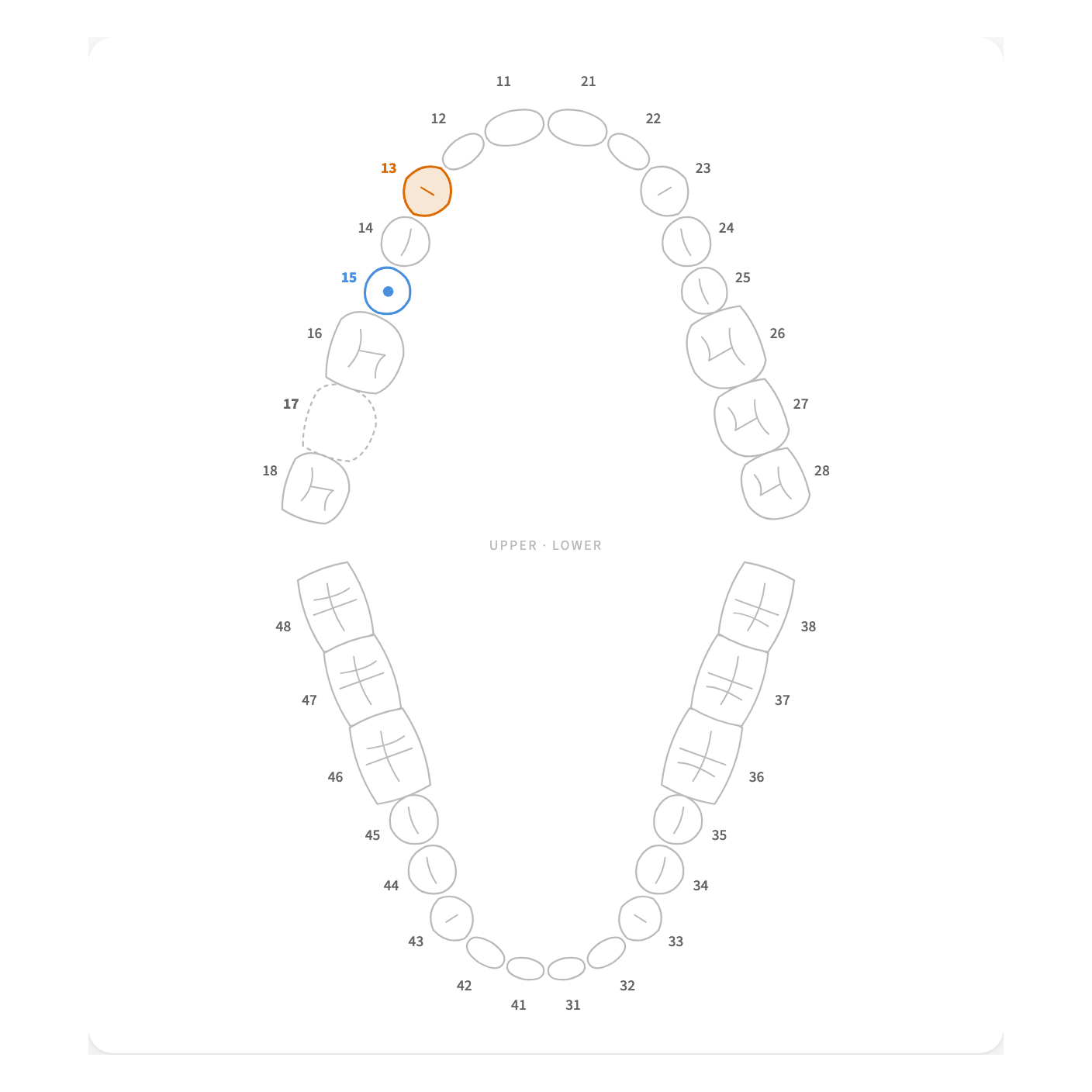
The dictated state: tooth 13 has decay, 15 has a filling, 17 is missing.
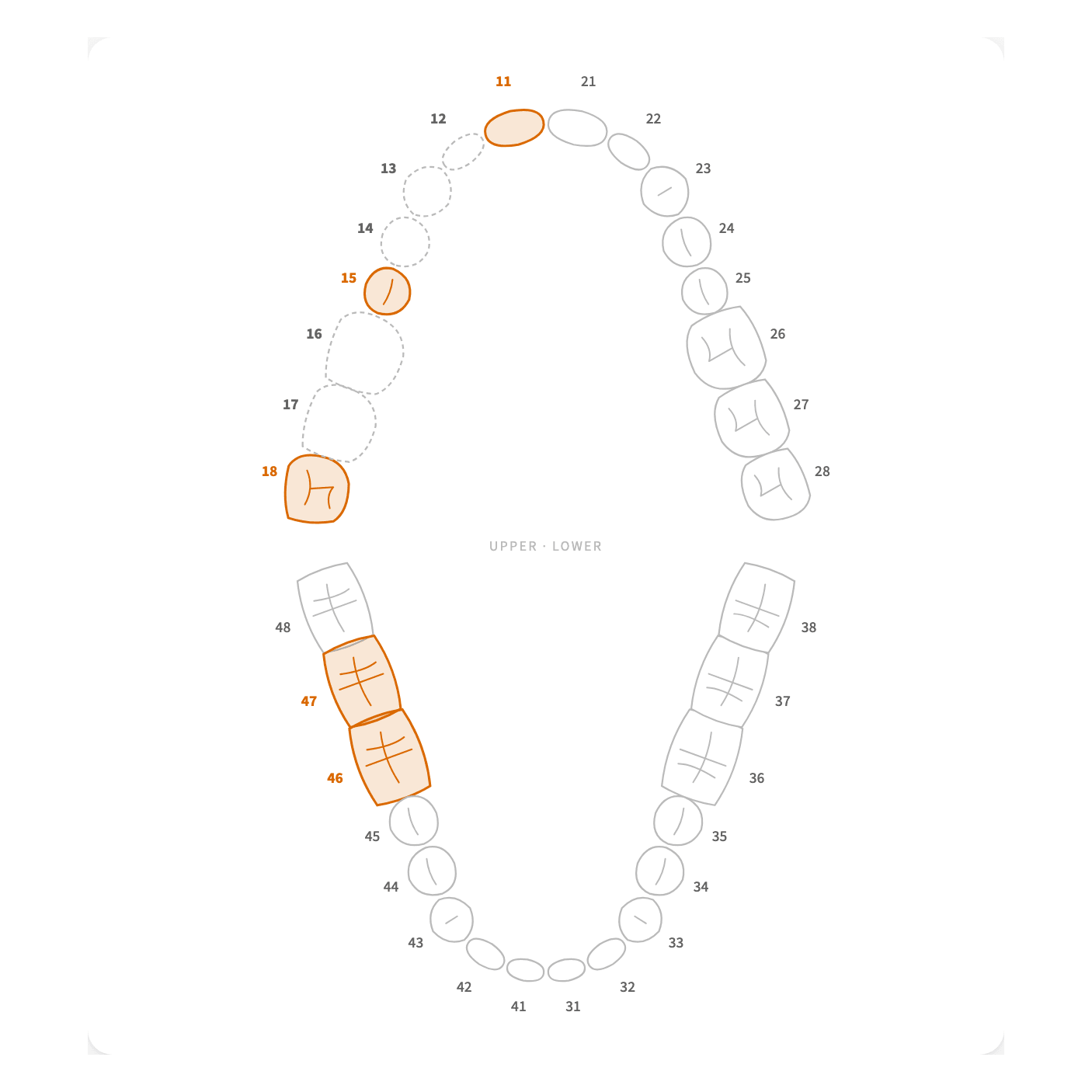
What happens without treatment? — 20 years
Features
What Dentlog does
Every feature serves one goal: your practice's time should go to treatment, not administration.
Voice capture
You dictate at the chair, hands-free — in sterile conditions too. Assistant note-taking drops out of the process.
AI interpretation to dental standards
FDI numbering, surfaces, procedure types: the spoken sentence becomes a standard, structured entry. On an uncertain sentence the system asks back — it doesn't guess.
Visual tooth map
Always shows the current state, with the latest visit's changes highlighted. This is the chart's “cover page” — one glance shows the whole mouth.
History per tooth
Every tooth has its own timeline: when what happened, with what material, who recorded it. Tapping the tooth opens the full history.
Delta dictation
With a returning patient, Dentlog shows the last state and you only say the change — “the filling in 15 is fine, new: decay starting on 24”.
Prognosis timeline
A draggable timeline on the tooth map: what to expect in 3, 5, 10, 20 years if the problem stays untreated. The strongest argument for accepting a treatment plan.
Practice workflow
Fast patient search, switching between chairs, several clinicians in one practice, permissions. More chairs, more doctors — one system.
Safeguards
Safety and responsibility
A dental chart is health data, and dictation is medical documentation — Dentlog is built accordingly, from day one.
The AI documents, it doesn't diagnose
Dentlog records the spoken finding — it makes no decisions and suggests no treatment. Diagnosis and therapy stay in your hands: this is a documentation tool, not decision support.
Doctor approval
Every AI entry becomes part of the chart only after your confirmation. A misheard sentence can be fixed with one tap before it gets in.
Health data handling
The chart is special-category (health) data: EU storage, encryption, per-practice data isolation, GDPR compliance from the first version — not retrofitted.
Audit log
Every entry shows who recorded it, when, by dictation or by hand, and who approved it. In medical documentation this isn't an extra — it's the baseline.
Fallback path
In a noisy room or with a mic failure, everything can be recorded by tapping and typing too. Dictation is a speed-up, not a dependency — the app is a full chart without it.
Language accuracy
Recognition is tuned to dental terminology and keeps learning from real practice dictations. We measure the mishearing rate — we don't estimate it.
Be among the first practices
Dentlog is taking shape right now, and the first practices' work shapes it. Request a demo and see it on your own workflow — with no commitment.